
Quick Answer
Your first hours in Game of Thrones: Kingsroad should focus on three things: choosing a comfortable class (Knight is safest for beginners), tuning your camera and UI settings before judging combat, and following the main story as your primary progression path while completing aide quests when they are efficient. Do not spend rare materials or premium currency until you understand your build direction. The game is fully playable as F2P — monetization popups are convenience offers, not requirements.
Field Notes
- • Follow main story quests as your spine. Side objectives and aide quests fill level gaps when you fall behind.
- • Tune camera speed, UI scale, and performance settings before deciding that combat feels bad.
- • Start crafting healing potions as soon as the system unlocks — you will need them for every boss fight.
- • Do not spend premium currency or rare materials during your first few hours. Test your class and build direction first.
- • Clear your inventory regularly. Selling common gear and decomposing uncommon items prevents frustrating bag-full moments.
Quick Summary
Game of Thrones: Kingsroad is a free-to-play action RPG set in the Game of Thrones universe, featuring open-world exploration, class-based combat, and a main story campaign with dozens of hours of content. It launched worldwide in May 2025 on iOS, Android, Steam, and the Epic Games Store, and supports cross-platform play.
If you are starting fresh, here is the essential advice: choose Knight if you want the safest beginner experience, tune your settings before judging the combat, follow the main story as your primary path, and do not spend rare materials or real money until you understand your build direction. The game is fully playable without spending — monetization popups are convenience offers, not walls.
This guide walks you through your first ten hours step by step, explains the core systems you will encounter, and points you toward the right next guide for every decision.
Your First Day: Step by Step
Character Creation and Class Choice
When you start the game, you will create a character and choose one of three classes: Knight, Assassin, or Sellsword. Each class has a distinct combat rhythm, and the choice affects how you learn the game.
Knight is the safest pick for beginners. Its defensive tools — blocking, parrying, and survivability — give you more time to learn enemy patterns and recover from mistakes. If you are new to action RPGs, playing on mobile, or want the smoothest early progression, Knight is the easiest recommendation.
Assassin is the fastest damage class based on early player discussions. It rewards clean execution, fast combos, and good positioning. It can feel excellent if you enjoy speed and mobility, but it punishes missed dodges and camera errors more than Knight does.
Sellsword (sometimes called the mercenary in translations and community discussions) focuses on heavy attacks and sustained pressure. It feels powerful when enemies group up but slower during single-target boss fights. Suits patient players who enjoy deliberate combat.
For a detailed class comparison, read the best class guide and class tier list.
The First 30 Minutes
The opening tutorial introduces movement, basic attacks, dodging, and the early story. Pay attention to the combat prompts — they teach the fundamentals you will use for the entire game.
During this window, the game will also introduce early systems such as equipment, skills, and possibly crafting. Do not rush through the system explanations. Read the tooltips and in-game descriptions. Kingsroad introduces several mechanics in quick succession during the early hours, and it is easy to miss important details.
First Hour: Tune Your Settings
Before you judge whether combat "feels good," tune your settings. This is one of the most important things a beginner can do, and it is the step most new players skip.
| Setting | What To Check | Why It Matters |
|---|---|---|
| Camera speed | Can you track enemies without overshooting? | Poor camera makes every class feel worse |
| UI scale | Can you read text and prompts comfortably? | Small text causes missed warnings |
| Visual effects | Do particles or bloom hide enemy attack tells? | Cluttered visuals make bosses harder to read |
| Frame rate | Is performance stable in combat areas? | Unstable frames make dodge timing unreliable |
| Touch / controller | Are dodge and attack buttons comfortable? | Awkward placement causes missed inputs |
If you play on mobile, pay extra attention to button placement and camera drag sensitivity. If you play with a controller, test dead zones and dodge/attack layout. If you are on Steam Deck, balance frame rate target with battery and UI readability.
For a full settings walkthrough, read the best settings guide and the mobile settings guide.
Core Systems Every Beginner Should Know
Kingsroad has several interconnected systems that affect your progression. Understanding them early prevents wasted resources and frustration later.
Momentum
Momentum is the game's overall power rating. It combines your gear stats, enhancements, sigils, artifacts, and other progression elements into a single number. Many pieces of content have a recommended momentum level — if yours is significantly below that number, expect a harder fight.
You increase momentum by upgrading gear, crafting better equipment, investing in sigils and artifacts, and improving your character's stats. For a full breakdown, read the momentum guide.
Potion Crafting
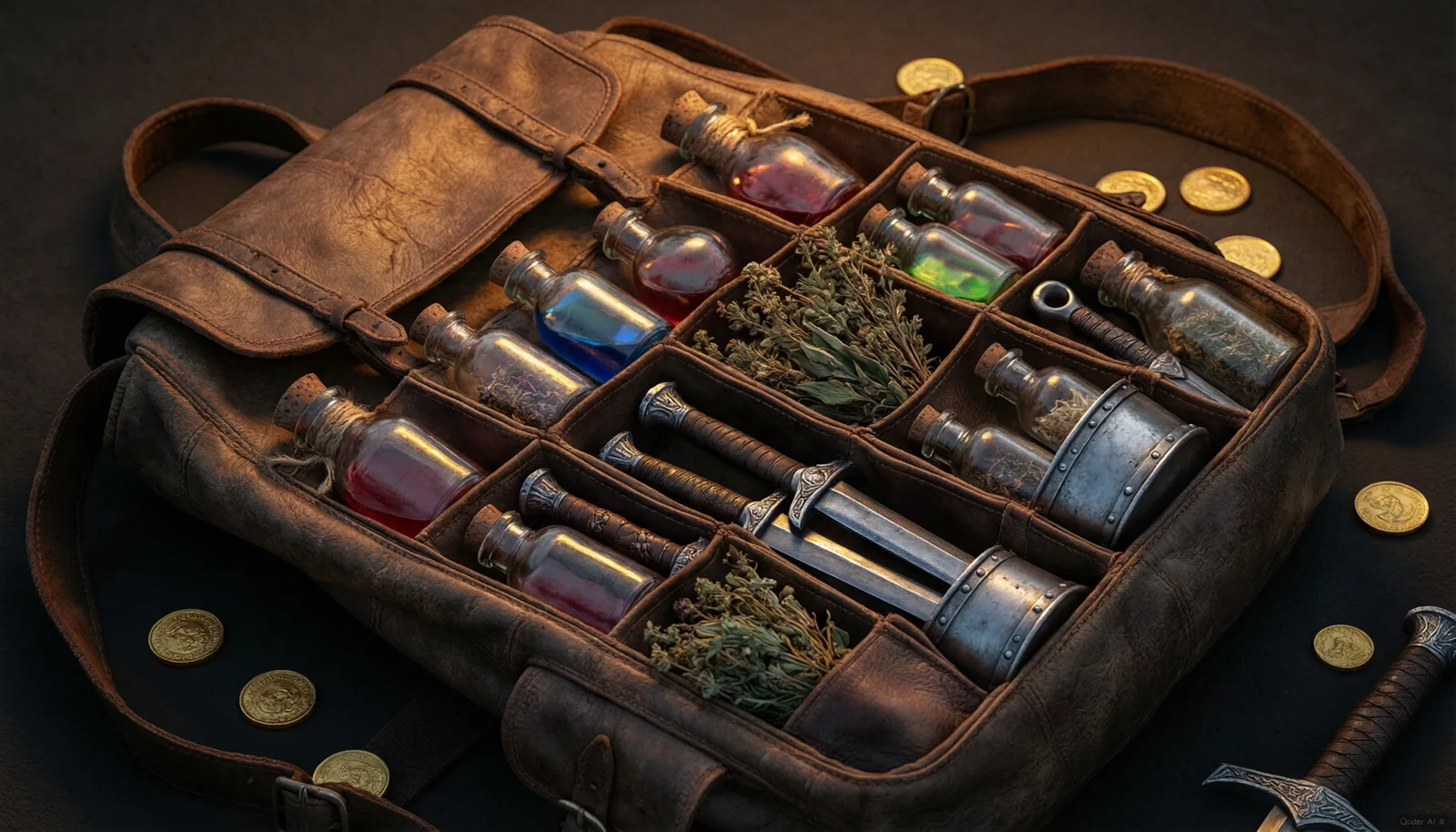
Potion crafting unlocks as you progress through the early story. Once available, it becomes one of your most important survival tools. Healing potions should be your top crafting priority — they directly prevent deaths during boss fights and tough encounters.
Gather herbs during every exploration session. Build a habit of maintaining a buffer of at least ten to fifteen healing potions before attempting any boss. Stamina potions are the next priority for melee classes that dodge and block frequently.
The beginner tips guide covers potion crafting in more detail.
Inventory Management
Inventory space is limited, and it fills up faster than most new players expect. Every gear drop, crafting material, and consumable takes a slot. Without regular maintenance, you will hit the cap at the worst possible moment — usually during a quest or dungeon where you want to pick up a valuable drop.
Build a simple habit: after every major quest or dungeon, spend two minutes clearing inventory. Sell common and uncommon gear you will never use. Decompose items that can be broken into crafting materials. Keep your active inventory focused on what you need for your current session.
Community discussions about full inventories are among the most common new player threads. A regular cleanup routine prevents this frustration entirely.
Quick Access
Quick access lets you assign potions and consumables to easily reachable slots during combat. This is especially important on mobile, where navigating menus mid-fight is more cumbersome than on PC.
Configure your quick access so that healing potions are in the most accessible slot, stamina potions in the second slot for melee classes, and any class-specific consumables in the remaining slots. Revisit your quick access configuration as you unlock new potions and consumables.
Daily and Weekly Tasks
Daily and weekly tasks provide steady resource income that compounds over time. Even short play sessions should include a quick task sweep. Skipping them means leaving free resources on the table — resources that directly contribute to your momentum and build progression.
Make daily tasks part of your login routine, especially if you play in shorter sessions.
Progression Path: Your First 10 Hours
Main Story First
Main story quests are your strongest free progression path. They unlock new systems, areas, and reward tiers that side content alone cannot reach. Follow the main campaign as your spine and treat everything else as a supplement.
The story is one of Kingsroad's strongest features according to community discussions. Players consistently praise the voice acting, Game of Thrones atmosphere, and world design. Do not rush through it — the narrative experience is a significant part of why many players recommend the game despite its monetization model.
Aide Quests and Side Objectives
When your level falls slightly behind the recommended level for the next main quest, complete nearby aide quests and side objectives. These fill level gaps, provide supplementary resources, and sometimes unlock useful items.
The key word is efficiency. Complete side content when it is along your route or requires minimal backtracking. If a side objective pulls you far from your main path, skip it and return later.
When to Explore the Open World
Kingsroad's open world contains gatherable herbs, hidden chests, environmental details, and occasional encounters that feed into potion crafting and progression. Exploration is rewarding, but it should not replace main story progress during your first ten hours.
A good balance: follow the main story, complete nearby side content, and explore off-path when you notice something interesting. Do not feel obligated to clear every corner of the map before moving forward.
Drogon World Boss
The Drogon world boss is a recurring event that multiple players can fight together. Community discussions suggest it is accessible even to free players and provides rewards that contribute to momentum progression. Participate when the event is available — it is a low-risk way to earn resources and experience group combat.
For a detailed Drogon strategy, read the Drogon world boss guide.
Platform Choice: Mobile vs PC
Kingsroad supports cross-platform play, meaning your progression carries between mobile and PC. But the experience differs significantly between platforms.
| Factor | PC | Mobile |
|---|---|---|
| Story and boss content | Better camera control, performance, and immersion | Convenient but smaller screen and touch controls |
| Daily tasks and grinding | Less convenient for short sessions | Great for commuting and short play windows |
| Controller support | Full controller support praised by community | Mobile controller mapping has some gaps |
| Performance | Generally better, especially on dedicated hardware | Can overheat on flagship phones during long sessions |
| First impression | Some PC players feel it looks like a mobile port | More aligned with mobile player expectations |
Based on community discussions, many experienced players recommend PC with a controller for story and boss content, and mobile for daily tasks and shorter sessions. The hybrid approach takes advantage of each platform's strengths.
For platform-specific optimization, read the mobile vs PC guide, controller support guide, and Steam Deck settings.
F2P Mindset: What New Players Should Know
Kingsroad is a free-to-play game with live-service monetization. Understanding how the monetization works — and how to ignore it — is part of a healthy beginner experience.
Monetization Popups Are Not Walls
The game will present premium currency offers, bundle deals, and time-limited shop items at various points during progression. These are convenience offers, not requirements. The main story, open world, boss fights, and class progression are all accessible without spending.
Many new players feel pressured by aggressive popup timing, especially during the mid-game when upgrade costs increase. Dismiss these without guilt. If the game is enjoyable after several hours and you want to support it or accelerate progression, you can make an informed decision later.
Do Not Spend During Your First Few Hours
Your first few hours should be about testing whether you enjoy the game, not about optimizing spending. Wait until you understand your play patterns, your class preference, and your build direction before considering any purchase.
Battle Pass
The battle pass is the most structured monetization in Kingsroad. It offers a free track with basic rewards and a paid track with additional items. Community discussions have noted the battle pass price as a point of frustration, with some players questioning whether the value justifies the cost.
Do not buy the battle pass until you have played enough to understand your session patterns. If you play daily and would naturally earn most of the free track rewards, the paid track may offer good value. If you play casually, it may not.
For a complete F2P strategy, read the F2P guide.
First 10 Hours Checklist
| Priority | Action | Why It Matters |
|---|---|---|
| 1 | Tune camera, UI, and performance settings | Prevents false judgments about combat feel |
| 2 | Choose one class and test its rhythm | Comfort matters more than tier list ranking |
| 3 | Follow main story as primary path | Unlocks systems, areas, and core rewards |
| 4 | Complete nearby aide quests when level gaps appear | Fills experience and resource gaps efficiently |
| 5 | Start potion crafting when it unlocks | Healing potions prevent deaths in every boss fight |
| 6 | Clear inventory after every major quest | Prevents frustrating bag-full interruptions |
| 7 | Configure quick access with healing potions | Faster access during combat saves lives |
| 8 | Do daily tasks even in short sessions | Steady resource income compounds over time |
| 9 | Save rare materials until build direction is clear | Prevents expensive mistakes that are hard to recover |
| 10 | Ignore monetization popups during first hours | They are convenience offers, not requirements |
Common Mistakes New Players Make
The most painful beginner mistakes fall into a few categories:
Resource mistakes — Spending rare materials on experimental builds, spreading upgrades across too many weapons, or buying premium consumables before understanding their value. These mistakes are the hardest to recover from because rare materials take significant time to re-accumulate.
Settings mistakes — Playing with default camera speed, tiny UI text, or unstable performance and then blaming the combat or the class. A few minutes of tuning can completely change how the game feels.
Combat mistakes — Chasing damage before learning defense, attacking during unsafe windows, or not reading enemy attack tells. These habits slow boss progression and waste time on repeated failures.
Platform mistakes — Not adjusting settings for mobile or Steam Deck, not testing controller layout, or assuming a build that works on desktop will feel the same on a smaller screen.
The beginner mistakes guide covers each of these in detail with specific recovery advice.
Patch Caution
Early-game progression, class balance, shared progression, and monetization rules can change after an update. Use this guide to set safe priorities, then confirm any time-sensitive mechanic in the current in-game menu or official update notes before spending limited resources.
FAQ
Is Game of Thrones: Kingsroad good for beginners?
Yes. The game includes a tutorial sequence, a main story campaign with 40+ hours of content, and three distinct classes with different difficulty levels. Knight is specifically designed as a forgiving entry point for players new to action RPGs.
How long is the main story?
Community discussions suggest 40+ hours of main story content, with additional side quests, open-world exploration, and endgame activities. Some players report 100+ hours and still having content to explore.
Can I change my class later?
You can create multiple characters to try different classes. Some progression systems may be shared between characters, but check current in-game menus before assuming what transfers.
What should I spend gold on first?
Upgrade your main weapon and core armor pieces. Avoid spending gold on cosmetics, experimental builds, or consumables you can craft. The beginner tips guide covers resource priorities in more detail.
What is the best class for mobile beginners?
Knight is the safest mobile beginner class because defensive play gives you more time to react, and touch control mistakes are less punishing than on faster classes.
Should I play on mobile or PC?
Both are viable. PC with a controller offers better camera control and performance for story and boss content. Mobile is more convenient for daily tasks and shorter sessions. Cross-platform play means you can use both.
Is the game pay to win?
Based on community discussions, paying accelerates progression and convenience rather than gating core content. F2P players report being able to clear main story and boss content with patience and smart resource management. Competitive PvP modes may favor paying players depending on current balance.
What To Read Next
After your first ten hours, you will have a clearer sense of your class, your build direction, and what content you want to focus on. Here are the most useful next guides:
- Best Beginner Build — Specific stat priorities, skills, and gear for each class
- Best Class Guide — Detailed class comparison if you are still deciding
- Beginner Tips — Potion crafting, inventory management, and daily habits
- Beginner Mistakes — Common errors and how to recover from them
- F2P Guide — How to progress efficiently without spending money
- Best Settings — Full settings optimization walkthrough
- Equipment Guide — Crafting, refinement, and gear set options
- Momentum Guide — How to increase your overall power rating
Last Updated: 2026-06-16
Note: This is an independent fan-made guide. It is not affiliated with HBO, Warner Bros., Netmarble, or the official Game of Thrones: Kingsroad team. Game mechanics, system details, and monetization specifics may change after updates. Always verify important details in-game.
Guide Navigation
Continue Reading
Classes
8 min readBest Class in Game of Thrones: Kingsroad – Tier List, Builds & Beginner Picks
Find the best class in Game of Thrones: Kingsroad by player type, including beginners, solo players, mobile players, damage-focused players, and survivability-focused players.
Classes
8 min readGame of Thrones: Kingsroad Class Tier List
A current Game of Thrones: Kingsroad class tier list for Assassin, Knight, and Sellsword, ranked for damage, survivability, progression, mobility, and beginner comfort.
Beginner
25 min readGame of Thrones: Kingsroad Tips and Tricks — 21 Essential Tips for New Players (2026)
21 practical tips and tricks for Game of Thrones: Kingsroad, updated September 2026: the daily routine that compounds resources, jewelry-first momentum strategy, animation canceling and boss combat techniques, gear upgrade rules, and F2P spending advice.
Related Guides
Classes
Best Class in Game of Thrones: Kingsroad – Tier List, Builds & Beginner Picks
Find the best class in Game of Thrones: Kingsroad by player type, including beginners, solo players, mobile players, damage-focused players, and survivability-focused players.
Builds
Game of Thrones: Kingsroad Best Beginner Build — Stats, Skills & Gear for Every Class
A practical beginner build guide for Game of Thrones: Kingsroad covering stat priorities, core skills, gear direction, and resource management for Knight, Assassin, and Sellsword.
Beginner
Game of Thrones: Kingsroad Beginner Mistakes — 20 Errors and How to Fix Them
The 20 most common beginner mistakes in Game of Thrones: Kingsroad, based on real player discussions and video guides. Covers sigil box waste, legendary equipment errors, momentum stagnation, aide quest neglect, Golden Dragon misuse, and how to recover from each mistake.
Beginner
Game of Thrones: Kingsroad Tips and Tricks — 21 Essential Tips for New Players (2026)
21 practical tips and tricks for Game of Thrones: Kingsroad, updated September 2026: the daily routine that compounds resources, jewelry-first momentum strategy, animation canceling and boss combat techniques, gear upgrade rules, and F2P spending advice.